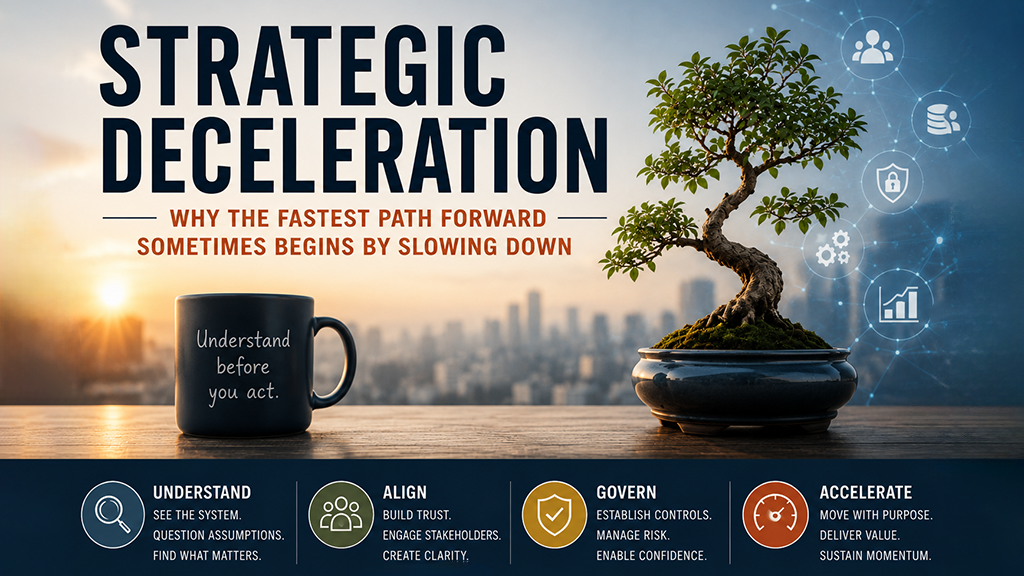
Strategic Deceleration: Why the Fastest Path Forward Sometimes Begins by Slowing Down
This article was originally posted on LinkedIn on May 10, 2026
In modern business environments, speed has become a virtue. We are told we must move fast or maintain a ‘bias for action’, and that deploying artificial intelligence systems before the competition amounts to a strategic advantage. Executives fear being left behind as boards demand visible progress, even as vendors promise transformational gains in record time.
The assumption that guides much of this rhetoric is simple: faster action leads to better outcomes.
In complex industries, that assumption is often wrong. Sometimes, the fastest path forward begins with slowing down long enough to understand what is being changed. I use the term strategic deceleration to describe the deliberate restraint of action to improve understanding before execution.
This principle is best illustrated by a technical bottleneck I encountered early in my career, where the pressure for immediate output collided with the need for systemic design.
A Lesson From My Early Career
Years ago, when I was working in CAD design, I was tasked with creating numerous similar CAD models. These models shared the same base design but varied in metadata, mounting hardware, and materials based on the use case. Rather than building each component manually, I spent two weeks developing a parametric base model. This deceleration period, in which I focused on a deep understanding of the problem and its solution, created management-level friction. From their perspective, my output did not meet expectations, and they didn’t understand why, after two weeks, I had exactly one part to show for my effort.
What was not immediately apparent was that this model had been designed to automatically generate more than 300 unique variations. With a few parameter changes and an embedded design table, the system produced an entire family of components with consistent geometry and metadata.
That foundational work ultimately saved approximately 600 design hours. What appeared to be a delay was really an architectural investment. Had I simply “hurried up and built” in accordance with standard practice, the organization would have spent hundreds of hours repeating work that could have been automated.
That early-career experience taught me a lesson that has stayed with me to this day: strategic deceleration can create exponential acceleration, and if deceleration creates such exponential value, we must examine why leadership circles remain fixated on a ‘bias for action’ that often excludes this foundational understanding.
The Problem with “Bias for Action”
A phrase I see consistently in leadership circles is ‘bias for action’. The concept certainly has merit in organizations that may be paralyzed by indecision, excessive meetings, and overanalysis. However, when applied indiscriminately, it devolves into something far less productive.
A bias for action without a bias for understanding is just institutional impulsivity.
In large organizations, taking action before understanding the system leads to technical debt, security risk, compliance issues, and expensive rework. Sure, teams appear to be moving quickly, but much of that energy is eventually spent on correcting avoidable mistakes.
Confusing motion with progress becomes particularly dangerous when the ‘vessel’ being moved is a complex enterprise rather than a nimble startup.
Startups Are Speedboats. Enterprises Are Aircraft Carriers.
The ‘move fast’ philosophy largely emerged from startup culture, where small high-velocity teams operating in loosely coupled systems are relatively buffered against the cost of failure. Startups are speedboats. They can pivot quickly.
Established enterprises are aircraft carriers.
They are massive, slow-moving sociotechnical systems comprising complex, highly interconnected legacy infrastructure, regulations, embedded business processes, and thousands of stakeholders. These ecosystems prioritize stable, reliable operations to ensure business continuity. Aircraft carriers do not pivot. They change course deliberately and with extensive coordination because abrupt maneuvers can destabilize the entire vessel. The same is true for large organizations facing digital transformation.
While carriers change course by choice, some leaders only learn the value of slowing down when forced – a lesson hidden in an unlikely cultural artifact.
An Unexpected Leadership Lesson from Cars
Disney’s Cars hides a profound leadership lesson. Lightning McQueen did not make a conscious decision to slow down; he was forced off course by circumstances beyond his control. The lesson for strategic deceleration here lies not in the detour itself, but in his response to it.
During his time in Radiator Springs, he gained a deeper understanding of what truly matters by building relationships, engaging in self-reflection, and valuing the components of the environment in which he had become part. When he returned to racing, he did so with greater maturity and purpose. McQueen’s “deceleration” wasn’t just about speed; it was about unlearning an individualistic mindset to understand a community ecosystem.
Organizations also experience similar unplanned disruptions. Project failures or security incidents force leaders to pause. The strategic opportunity is to use these moments of deceleration to better understand before speeding up again.
Whether forced or planned, the ability to pause is no longer just a leadership choice; it is a strategic necessity in the face of the widening gap.
The Exponential Gap
Azhar’s The Exponential Age describes the widening gap between technological acceleration and organizations ill-equipped to meaningfully adapt. Artificial intelligence is intensifying this gap tremendously.
Organizations are competing to deploy automated workflows and integrate machine learning into their operations. Yet, these same organizations struggle with fragmented data, weak governance, ambiguous ownership, and limited user trust. The result is that executives are accelerating transformation before fully understanding the systems they intend to change. In my experience, the outcome is a mess.
Defining Strategic Deceleration
Strategic deceleration is the deliberate slowing of organizational action to improve systemic understanding, strengthen governance, and increase the probability of sustainable success. It should not be confused with procrastination, nor is it bureaucracy for its own sake, nor is it resistance to innovation. It is a purposeful investment in understanding before scaling.
My process is straightforward:
- Slow down to understand the system.
- Identify dependencies, assumptions, and constraints.
- Build stakeholder alignment and trust.
- Establish governance and controls.
- Accelerate with confidence.
Slow down to understand. Understand to align. Align to accelerate.
This is sound in theory, but execution requires a shift in how we distinguish the speed of activity from the speed of meaningful progress.
Speed Is Not the Same as Progress
We, as managers, tend to equate rapid activity with meaningful progress. Aggressive execution within constrained timelines creates the appearance of momentum. But when requirements are unclear, dependencies are poorly understood, or trust is lacking, speed can generate technical debt and costly rework rather than sustainable value.
A useful heuristic is:

Speed remains important, but its impact depends on the strength of the other summands and the realization factor of trust. Once we account for this, we can evaluate the specific organizational dimensions in which deceleration yields the highest dividends.
A People–Technology–Economics Perspective
Strategic deceleration can be understood through a People–Technology–Economics (PTE) framework.
- People require time to interpret change, build trust, and adapt.
- Technology introduces architectural dependencies, security considerations, and emergent behaviors.
- Economics ultimately penalizes rework, outages, and failed adoption.
Aligning the three PTE lenses is not just an optimization; it is the critical differentiator in the current, high-stakes AI race.
Why This Matters for AI
The current AI race is partly fueled by a fear of missing out. Many organizations believe that the cost of slowing down is the loss of a competitive advantage, and that concern is not unfounded. However, the greater risk to complex enterprises is that they deploy AI systems without sufficient understanding of governance, explainability, security, and human oversight. The goal of strategic deceleration isn’t to be last; it’s to ensure that when we do move, we don’t have to stop to fix preventable problems that our competitors are currently baking into their infrastructure.
The organizations that derive the greatest long-term value from AI may not be those that capitalize on first-mover advantage. They may be the ones that pause long enough to build the strongest foundations as fast followers.
Final Thoughts
I have seen the consequences of premature acceleration repeatedly in large technology programs. Requirements are unclear. Dependencies are poorly understood. Governance is treated as an obstacle rather than an enabler. Teams rush forward, only to spend months repairing avoidable problems.
I have also seen the opposite.
A carefully designed foundation, whether a parametric CAD model or a deployment governance framework, may appear slow at first. But once the underlying architecture is in place, progress accelerates dramatically. Sometimes, as Lightning McQueen discovered, slowing down is not a sign of weakness. It is an opportunity to gain the understanding necessary to perform at a higher level. The same lesson applies to organizations. The goal is not to move slowly. The goal is to move with sufficient understanding to sustain acceleration.
In a world increasingly obsessed with speed, strategic deceleration may be one of the most important leadership capabilities of the AI era.
Portions of this article, including editorial refinement, formatting, organization of content, and draft revision were assisted by ChatGPT and Gemini. Grammarly was used for proofreading and language refinement. All analysis, arguments, conclusions, and final visualizations are the my own.