
Ethical Governance, Algorithmic Bias, and Workforce Transformation in Artificial Intelligence Deployment for Business and Project Management
Authors’ note: This AI-supported research paper experiment was completed for a class at Purdue University. I used Elicit (2026) and Gemini Notebook (Google, 2026) to produce a research paper based on instructor guidance. Elicit was used to identify source material. Gemini Notebook synthesized the selected sources and generated the manuscript. ChatGPT (OpenAI, 2026) refined the introduction and conclusion. The majority of this paper is AI-generated. Human oversight consisted of validating sources, citations, paraphrased claims, and revising grammar and formatting. The Looking Forward subsection is my own work. This paper is not published in any academic journals, nor has it been peer-reviewed. All evidence and claims should be considered preliminary.
Abstract
Artificial intelligence (AI) is expanding the use of predictive analytics, automated decision support, and algorithmic management across business and project management. These applications can improve forecasting, resource allocation, risk analysis, and operational efficiency, while also introducing concerns involving algorithmic bias, data privacy, accountability, workforce displacement, and overreliance on automated recommendations. This study examines how organizations address these concerns when deploying AI in business and project management contexts. A two-stage AI-mediated research workflow used Elicit for literature discovery and screening and NotebookLM for source-grounded thematic extraction, cross-source synthesis, and manuscript generation. Human review focused on validating source relevance, citations, paraphrased claims, and grammatical accuracy. Ten scholarly sources published between 2023 and 2026 were analyzed across project management, corporate governance, human resource management, workforce automation, algorithmic management, and AI fairness. The synthesis identifies recurring governance mechanisms that include bias auditing, explainable AI, privacy-enhancing technologies, regulatory compliance, continuous algorithmic monitoring, multidisciplinary oversight, and Human-in-the-Loop decision controls. The findings also indicate that effective AI governance depends on operational context and requires human professionals to evaluate, challenge, modify, or override algorithmic recommendations. As AI assumes a larger role in project and business decision support, project managers and business analysts increasingly serve as governance participants responsible for maintaining accountability, contextual judgment, and appropriate human oversight.
Keywords: artificial intelligence, project management, business analysis, algorithmic bias, AI governance, data privacy, workforce automation, human oversight
Introduction
Artificial intelligence (AI) is becoming embedded in organizational decision processes that were historically performed through human analysis, professional judgment, and conventional analytical tools. In project management and business analysis, AI systems increasingly support scheduling, resource allocation, risk forecasting, workforce analytics, performance evaluation, and operational decision-making. These capabilities can expand analytical capacity and speed decisions, but they also raise governance concerns about biased training data, opaque model behavior, privacy risks, employee surveillance, cybersecurity, workforce displacement, and unclear accountability for AI-supported decisions.
These concerns extend beyond technical model performance. Algorithmic fairness can require explicit organizational choices among competing fairness criteria, while opaque models can limit project managers’ and business analysts’ ability to evaluate the assumptions underlying automated recommendations. AI-supported workforce systems can also influence employee autonomy, workload, employment stability, and access to organizational opportunities. Organizations must consequently govern AI as a sociotechnical system in which technical controls, regulatory requirements, managerial processes, and human judgment interact. The literature examined in this study describes approaches that include Explainable AI, privacy-enhancing technologies, algorithmic auditing, formal governance frameworks, multidisciplinary oversight, and mechanisms that preserve human authority over consequential decisions.
This research addresses the following question: How do organizations address ethical concerns such as algorithmic bias, data privacy, and worker displacement when deploying AI in business and project management contexts? A structured AI-mediated review of ten recent scholarly sources examines both the ethical risks associated with organizational AI deployment and the governance mechanisms used to mitigate them. Elicit supported literature discovery and screening, while NotebookLM generated the thematic synthesis and manuscript from the selected source corpus. Human oversight focused on validating sources and verifying citations, paraphrases, and generated claims. The analysis addresses algorithmic bias, opacity, accountability, privacy, surveillance, cybersecurity, and workforce disruption before considering governance frameworks, predictive AI applications, and Human-in-the-Loop controls affecting project management and business analysis.
Methodology
This section describes the two-stage AI-mediated research workflow used to identify, synthesize, and generate the literature-based manuscript addressing RQ1. To maintain rigorous academic standards and temporal relevance, literature discovery was conducted via Elicit.com (Stage 1), enforcing a strict 3-year publication window (2023–2026). The study selected ten scholarly sources, including peer-reviewed journal articles, systematic reviews, and authoritative guidance briefs. Next, the source corpus was ingested into NotebookLM (Stage 2) for grounded semantic analysis, thematic insight extraction, and cross-source synthesis to support discussion of ethical implications and future vision. The methodological framework outlines the research design, search mechanics, prompt strategies, quality-control protocols, and anti-hallucination verification steps.
1. Methodological Framework
Conducting a robust literature synthesis requires methodological precision to filter low-quality studies, eliminate outdated empirical data, and systematically synthesize findings across disparate domains. This study implements a structured, dual-tool AI research workflow that combines semantic literature search capabilities with grounded knowledge extraction.
The research design segregates technological capabilities into two distinct procedural phases: (a) Stage 1: Literature Discovery, Temporal Filtering, and Screening via Elicit.com; and (b) Stage 2: Knowledge Ingestion, Semantic Prompting, and Grounded Synthesis via NotebookLM. By establishing clear boundaries between literature identification and analytical synthesis, the workflow ensures comprehensive coverage of current scholarship while mitigating algorithmic hallucination.
2. Stage 1: Academic Literature Search and Screening via Elicit.com
Stage 1 focused on broad academic literature discovery and screening utilizing Elicit.com, an AI-powered research assistant built upon large-scale language models trained on scientific literature repositories (e.g., Semantic Scholar).
2.1 Search Mechanics and Query Formulation
To identify relevant scholarly contributions addressing RQ1, the study formulated and submitted natural-language semantic queries to Elicit.com. Unlike traditional keyword-based Boolean search engines, Elicit processes semantic intent, enabling deep conceptual matching across titles, abstracts, and full texts. The primary search query was:
How do organizations address ethical concerns such as algorithmic bias, data privacy, and worker displacement when deploying AI in business and project management contexts?
2.2 Inclusion and Exclusion Criteria
A rigorous screening protocol was established to ensure that all retrieved literature met academic standards. The screening parameters enforced were:
- Temporal Restriction: Publication Window:
- Only scholarly sources published within the last three years (2023–2026) were included, capturing the most recent developments in generative AI and legal regulations.
- Document Type: Source Quality:
- Inclusion was restricted to peer-reviewed journal articles, systematic literature reviews (e.g., PRISMA-compliant reviews), and authoritative guidance briefs from established research institutions.
- Content Relevance: Thematic Alignment:
- Selected literature had to explicitly address at least two of the core ethical dimensions embedded in RQ1 (algorithmic bias, data privacy, employee surveillance, worker displacement, or human-centered AI governance).
2.3 Screening Results and Verification
The initial Elicit search yielded 12 candidate papers. Applying the publication date filter (2023–2026) reduced the corpus to 10 relevant studies (Figure 1). Abstract screening and methodology evaluation confirmed the selection of N = 10, collectively providing empirical and theoretical support for both ethical implications and future vision.
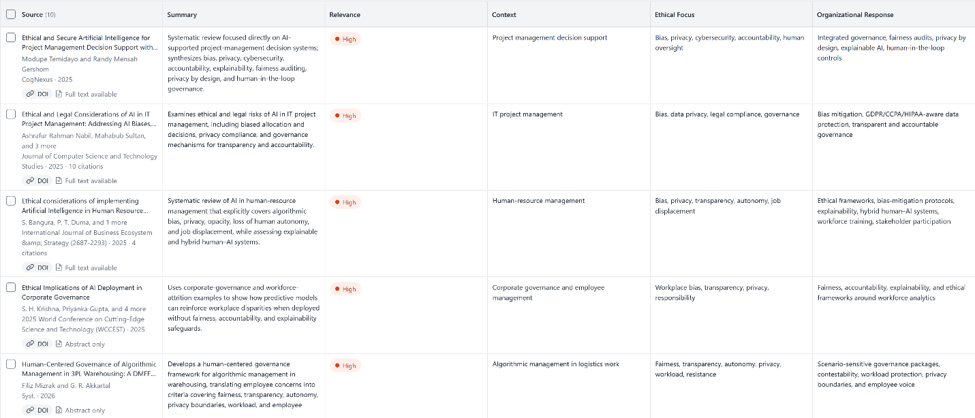
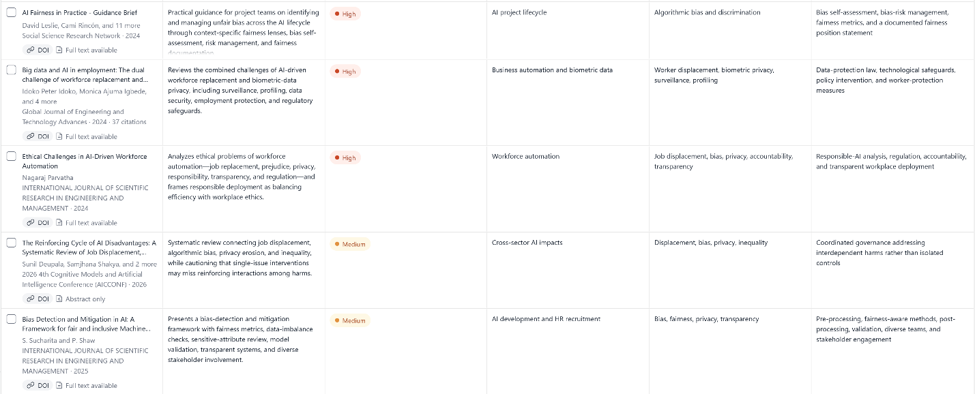
Figure 1: Elicit Screening Results
3. Stage 2: Knowledge Ingestion, Extraction, and Synthesis
After selecting the literature in Stage 1, the full-text PDFs of the ten selected papers were imported into Zotero for citation management and then uploaded to Google NotebookLM (Gemini Notebook). NotebookLM functions as an air-gapped, source-grounded analytical workspace that restricts response generation strictly to the provided source corpus.
3.1 Source Ingestion and Corpus Curation
The ten ingested sources encompassed diverse domain perspectives, including IT project management (Nabil et al., 2025; Temidayo & Gershom, 2025), corporate governance (Krishna et al., 2025), human resource management (Bangura et al., 2025), logistics algorithmic management (Mizrak & Akkartal, 2026), workforce replacement (Idoko et al., 2024; Parvatha, 2024), systemic inequality (Deupala et al., 2026), bias detection tooling (Sucharita & Shaw, 2025), and practical fairness governance (Leslie et al., AI Fairness in Practice – Guidance Brief, 2024).
3.2 Grounded Semantic Prompting
Within the NotebookLM environment, targeted prompts extracted specific empirical findings, theoretical models, and governance strategies. The prompt was structured to map directly onto the research paper’s mandate:
Research question (RQ1): How do organizations address ethical concerns such as algorithmic bias, data privacy, and worker displacement when deploying AI in business and project management contexts?
Goal: Extract key insights and synthesize information from the included sources to support a research paper addressing the research question.
Part A – Ethical Implications: Investigate and analyze the ethical challenges and considerations when implementing AI in business and project management contexts. Consider aspects such as bias, transparency, accountability, privacy, and data security. Support the analysis with current research and industry examples.
Part B – Future Vision: Develop a forward-looking analysis of how AI will transform project management and business analysis. Examine emerging trends, implementation approaches, and impacts on professional roles. This should be grounded in current research while providing innovative insights for the future.
Guidance:
- APA 7 formatting is required. Citations must be in-line with the author cited as: (Lastname, Year)
- Any additional outside sources should be sourced from AI project management research, artifacts, and scholarly references. Qualitative sources and other grey literature, such as industry reports and white papers, may be used to support the paper.
- Any claim made should be supported by a source.
- All sources must have been published within the last 3 years.
- A minimum of 10 sources must be used. Support Part A and Part B with at least 5 sources each.
- Do not offer a suggestion and then immediately suggest a revised version. Create a final output and provide it only once. If I need revisions or additional options, I will ask.
- Be concise and academically professional. My audience consists of doctoral professors and project management professionals who are highly knowledgeable in their fields.
- Avoid the use of antithesis, simile, analogy, and metaphor. The style should be academic, not conversational.
3.3 Cross-Source Synthesis and Verification
NotebookLM’s multi-source semantic processing cross-referenced the ten documents and identified thematic convergence across the source corpus (Figure 2). This facilitated identifying thematic convergence—such as the mathematical trade-off between demographic parity and predictive accuracy highlighted in Deupala et al. (2026) and Leslie et al. (2024)—as well as scenario-dependent governance priorities established by Mizrak and Akkartal (2026).
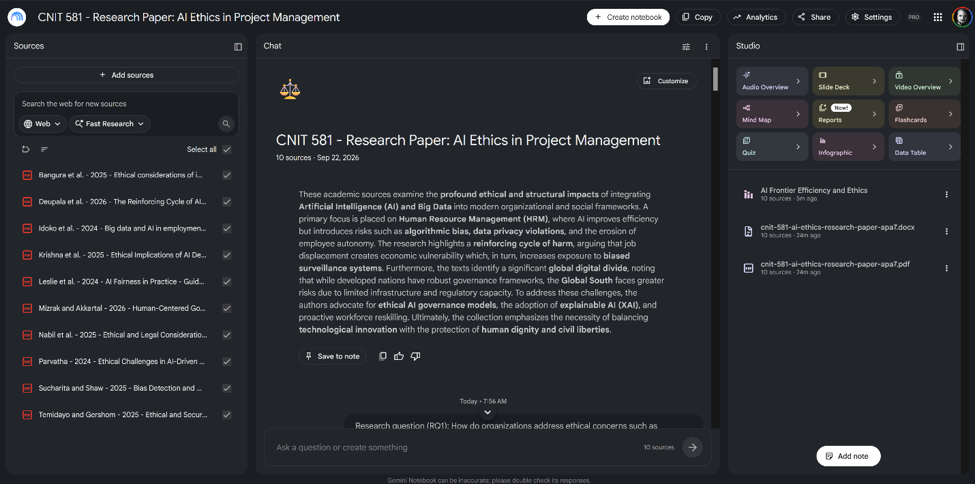
Figure 2: Cross-Source Synthesis in NotebookLM
4. Research Workflow Architecture
The systematic integration of Elicit.com and NotebookLM is illustrated in Figure 3 below. The diagram depicts the sequential progression from initial search query formulation to final grounded manuscript generation.
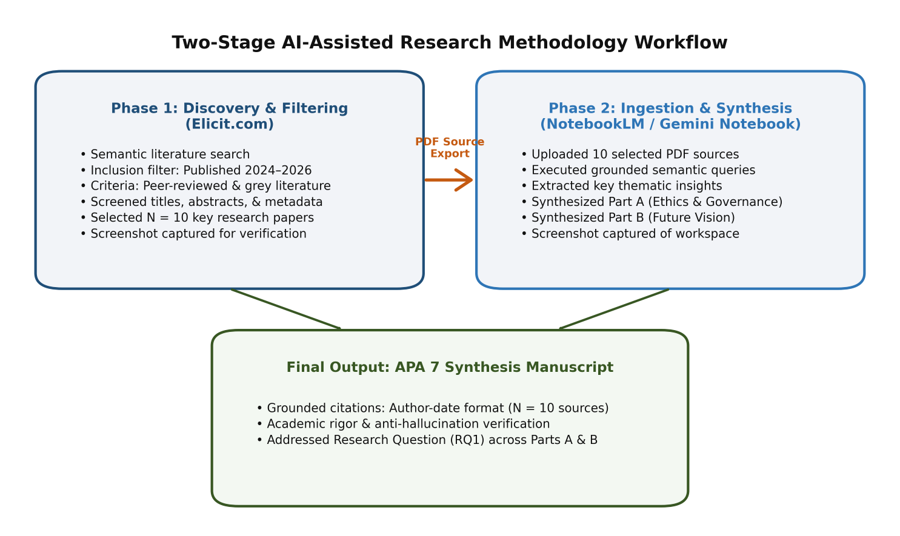
Figure 3: Research Workflow Architecture
5. Methodological Rigor, Grounding, and Ethical AI Compliance
Deploying generative AI tools in academic research introduces risks of hallucination, misquotation, and uncritical adoption of automated outputs. To safeguard academic integrity and satisfy doctoral review standards, strict quality control protocols were enforced:
- Anti-Hallucination Protocol: Strict Grounding Verification:
- Every factual claim, statistic, legal framework, and author attribution in the final paper was cross-checked against the primary PDF source texts. NotebookLM’s source citation feature was utilized to verify passage origins.
- Human Oversight and Source Validation: Human-in-the-Loop Oversight:
- Generative AI performed most of the thematic extraction, cross-source synthesis, narrative development, and manuscript generation. The researcher provided the research question, task requirements, source-selection parameters, and prompting constraints. Human oversight focused on validating the relevance and authenticity of the selected sources, checking citations and paraphrased claims against the original publications, correcting grammatical or formatting issues, and reviewing the generated manuscript for unsupported or inaccurate content. AI-generated material was retained only when its associated claims could be substantiated by the source corpus.
- Stylistic Compliance: Style and Tone Enforcement:
- The final manuscript was reviewed to remove rhetorical devices such as metaphors, similes, and antitheses, maintaining an objective, concise, and academically professional prose style.
Discussion:
Algorithmic Bias Mechanics and Mathematical Fairness Trade-offs
Algorithmic bias represents a persistent structural vulnerability in automated decision-support frameworks deployed across project management and human resource environments (Nabil et al., 2025). Machine learning models derive predictive patterns from historical training data that frequently reflect institutional and historical inequalities (Nabil et al., 2025). When deployed for recruitment, employee engagement, or performance evaluation, models trained on biased historical records perpetuate systemic inequalities against underrepresented demographic groups (Bangura et al., 2025).
Pre-training data imbalances and sensitive attributes produce disparate impacts across workforce demographics (Sucharita & Shaw, 2025). Algorithms optimized solely for predictive accuracy generate biased recommendations because mathematical loss functions do not inherently incorporate equity criteria (Leslie et al., AI Fairness in Practice, 2024). Furthermore, mathematical definitions of fairness conflict; efforts to correct racial bias introduce direct trade-offs with predictive accuracy (Deupala et al., 2026). Formal criteria such as equalized odds and demographic parity are not simple technical fixes within machine learning architecture but require deliberate value choices by organizational governance (Deupala et al., 2026).
In corporate governance and predictive workforce analytics, algorithms such as Random Forest, Support Vector Machines (SVM), K-Nearest Neighbors (KNN), and Gradient Boosting evaluate employee turnover probabilities based on historical performance indicators (Krishna et al., 2025). Unchecked deployment of these predictive tools reinforces workplace disparities by failing to account for qualitative social context (Krishna et al., 2025). Similarly, in industrial project management, biased training inputs lead to inequitable budget and time allocations, flawed stakeholder relationships, and distorted risk evaluations (Temidayo & Gershom, 2025).
Algorithmic Opacity, Explainability, and Accountability Gaps
Complex machine learning models and Large Language Models (LLMs) integrated into project decision support exhibit high structural opacity, commonly referred to as the ‘black-box’ phenomenon (Nabil et al., 2025; Temidayo & Gershom, 2025). This lack of interpretability prevents project managers and business analysts from verifying the underlying logic, assumptions, and constraints governing automated recommendations (Nabil et al., 2025; Temidayo & Gershom, 2025). In construction and engineering projects, LLM-driven decision tools can generate plausible but unverified advice, introducing operational risks through a lack of interpretability (Temidayo & Gershom, 2025).
Opacity conceals discriminatory procedural outputs, preventing affected personnel from challenging automated decisions (Deupala et al., 2026; Temidayo & Gershom, 2025). To reduce opacity, organizations adopt XAI (Explainable AI) frameworks that use TETs (Transparency-Enhancing Technologies) such as SHAP (SHapley Additive exPlanations) and LIME (Local Interpretable Model-agnostic Explanations) (Parvatha, 2024). These methods generate transparent trust and accountability factors, creating auditable decision logs for internal governance and regulatory compliance (Bangura et al., 2025; Parvatha, 2024; Temidayo & Gershom, 2025).
System opacity exacerbates accountability gaps across corporate structures (Bangura et al., 2025; Nabil et al., 2025). When an automated recommendation leads to project failure or discriminatory resource allocation, responsibility becomes diffused among software vendor developers, data engineering teams, corporate executives, and human project managers (Bangura et al., 2025; Parvatha, 2024; Temidayo & Gershom, 2025). Empirical industry cases highlight diverse responses: Amazon faced scrutiny over automated warehouse performance management algorithms, prompting shifts toward human oversight, while IBM integrated explainability tools into HR analytics so employees could audit performance scores (Krishna et al., 2025).
Data Privacy Regulations, Employee Surveillance, and Cybersecurity Safeguards
Deploying Big Data analytics and AI algorithms in business operations to improve efficiencies requires continuous ingestion of detailed operational, financial, and personnel information (Idoko et al., 2024; Temidayo & Gershom, 2025). Continuous workplace surveillance—through digital scanner logs, real-time KPI dashboards, and automated communication tracking—raises serious privacy concerns and employee distress (Bangura et al., 2025; Parvatha, 2024). In logistics and third-party warehousing, algorithmic pacing and intrusive surveillance elevate physical and psychological strain among workers (Mizrak & Akkartal, 2026).
Organizations must align data architecture with statutory frameworks, including the European Union’s General Data Protection Regulation (GDPR), the California Consumer Privacy Act (CCPA), and the Health Insurance Portability and Accountability Act (HIPAA) (Idoko et al., 2024; Nabil et al., 2025). These statutes mandate purpose limitation, explicit consent, data minimization, and the right to request data deletion (Nabil et al., 2025; Parvatha, 2024). Technical privacy-enhancing technologies (PETs) are increasingly implemented to ensure regulatory compliance:
- Differential Privacy: Injects calibrated mathematical noise into data queries to prevent individual re-identification during pattern analysis (Nabil et al., 2025).
- Federated Learning: Trains machine learning models across decentralized local edge devices without transmitting raw personal data to central servers (Idoko et al., 2024; Nabil et al., 2025).
- Privacy-by-Design Protocols: Embeds automatic data anonymization, end-to-end encryption, and role-based access controls directly into software infrastructure (Idoko et al., 2024; Nabil et al., 2025; Temidayo & Gershom, 2025).
Furthermore, cloud-based AI decision tools expand the enterprise attack vector, introducing vulnerabilities to adversarial manipulation, model poisoning, data extraction, and algorithmic tampering (Patil, 2024, as cited in Temidayo & Gershom, 2025). Tampered AI scheduling algorithms distort financial budgeting, risk forecasting, and resource allocations across project management environments (Temidayo & Gershom, 2025).
Worker Displacement, Labor Restructuring, and Socio-Economic Volatility
AI-driven workforce automation accelerates task substitution across administrative, operational, and project coordination roles (Brynjolfsson and McAfee, 2014, as cited in Deupala et al., 2026; Idoko et al., 2024). Routine cognitive and physical tasks such as manual data entry, basic inventory tracking, routine scheduling, and standardized customer services exhibit extreme displacement vulnerability (Deupala et al., 2026; Parvatha, 2024). Systematic reviews indicate that up to 47% of total occupational positions are vulnerable to computerization over the coming decades (Frey and Osborne, 2017, as cited in Deupala et al., 2026). Conversely, roles requiring non-routine problem solving, strategic vision, and complex human negotiation are less likely to be directly substituted (Temidayo & Gershom, 2025).
The rapid pace of task substitution outstrips institutional adaptation, generating compounding socio-economic divides (Deupala et al., 2026):
- Income Inequality Concentration: Automation disproportionately affects lower-wage routine labor, concentrating economic returns among owners of technology capital (Deupala et al., 2026; Acemoglu and Restrepro, 2018, as cited in Idoko et al., 2024).
- Structural Skill Mismatches: Emerging technical roles require advanced analytical skills that displaced routine workers cannot quickly acquire without organized transition programs (Deupala et al., 2026; Idoko et al., 2024).
- Psychological and Technostress Burdens: Abrupt workplace restructuring and continuous algorithmic monitoring induce technostress, job insecurity, and severe burnout (Bangura et al., 2025; Idoko et al., 2024).
- Public Safety Net Strain: Widespread structural displacement elevates demand for social welfare expenditures and governmental retraining initiatives (Idoko et al., 2024).
Emerging Methodological Trends and Predictive Analytics
The future landscape of project management and business analysis relies on integrating predictive AI decision support across all phases of the project lifecycle (Leslie et al., AI Fairness in Practice, 2024; Temidayo & Gershom, 2025). Advanced analytics shift project controls from reactive status reporting to real-time predictive forecasting, optimizing project scheduling, cost control, dynamic risk management, and resource leveling (Nabil et al., 2025; Temidayo & Gershom, 2025). In logistics and third-party warehousing operations, algorithmic management frameworks combine scanner data and real-time monitoring algorithms to maximize operational throughput (Mizrak & Akkartal, 2026).
To prevent pre-deployment failure, modern project methodologies incorporate data auditing tools prior to model training (Sucharita & Shaw, 2025). Automated bias detection dashboards scan raw data inputs for representation gaps, calculate Disparate Impact scores, and identify Personally Identifiable Information (PII) (Sucharita & Shaw, 2025). This operationalizes the Ethical AI Triangle, establishing an equilibrium between bias mitigation, fairness evaluation, and privacy protection during initial project scoping (Sucharita & Shaw, 2025).
Organizational AI deployments align with international risk management frameworks (Nabil et al., 2025; Temidayo & Gershom, 2025):
- NIST AI Risk Management Framework (AI RMF): Provides systematic guidelines for mapping, measuring, and managing operational vulnerabilities and algorithmic risks (Sawminathan and Danks, 2024, as cited in Temidayo & Gershom, 2025).
- ISO/IEC 42001 Standard: Establishes certifiable management system requirements for auditing data governance, privacy safeguards, and AI safety across enterprise projects (Dudley, 2024, as cited in Temidayo & Gershom, 2025).
- European Union AI Act: Enforces regulatory classifications through risk evaluations that support human rights and safety (Parvatha, 2024).
- OECD AI Principles: Guides international corporate governance toward trustworthy, human-centered AI deployment and transparent operational reporting (Parvatha, 2024).
Implementation Frameworks and Scenario-Sensitive Governance Effective implementation of AI in business environments requires scenario-sensitive governance rather than rigid compliance rules (Mizrak & Akkartal, 2026). The DMFF-BN-PCRO decision framework—integrating Dynamic Multi-Facet Fuzzy Sets, Bayesian Networks, and Principal Component Analysis ranking optimization—demonstrates that governance priorities dynamically adapt to surrounding operational conditions (Mizrak & Akkartal, 2026):
Table 1: Scenario-Sensitive Governance Priorities in Algorithmic Project Operations
| Operational Context | Primary Risk Factor | Governance Priority & Mechanism |
| Peak Season Surge | Worker fatigue and cognitive overload | Workload caps, metric explanation, and rapid manual exception overrides (Mizrak & Akkartal, 2026). |
| Labor Shortage / Turnover | Loss of institutional knowledge and disengagement | Simplified operational rules, dynamic feedback, and transparent onboarding rules (Mizrak & Akkartal, 2026). |
| Audit & Compliance Scrutiny | Regulatory penalties and procedural invalidity | Formal contestability logs, appeal records, and documented monitoring boundaries (Mizrak & Akkartal, 2026). |
Note. Adapted from DMFF-BN-PCRO decision framework empirical findings (Mizrak & Akkartal, 2026).
Comprehensive governance packages that integrate transparency, workload protection, and employee autonomy achieve superior operational stability compared to single-issue compliance policies (Mizrak & Akkartal, 2026). At the enterprise level, governance is built upon three pillars (Nabil et al., 2025):
- Regulatory Compliance: Direct mapping of project architectures to privacy statutes and international AI directives (Fjeld et al., 2020, as cited in Nabil et al., 2025).
- Algorithmic Auditing and Monitoring: Periodic post-deployment assessments to detect model drift, accuracy decay, and emergent bias (Raji et al., as cited in Nabil et al., 2025).
- Ethical AI Training: Multi-disciplinary oversight panels responsible for reviewing AI deployments (Boddington, 2017, as cited in Nabil et al., 2025).
Evolution of Professional Roles and Human-AI Collaboration
AI integration fundamentally redefines the roles of project managers, business analysts and human resource management (HRM), transitioning them from administrative controllers to strategic decision orchestrators and ethical stewards (Bangura et al., 2025; Nabil et al., 2025; Temidayo & Gershom, 2025). Project professionals oversee predictive model outputs, evaluating algorithmic recommendations against qualitative organizational context, stakeholder expectations, and societal values (Bangura et al., 2025; Nabil et al., 2025).
A principal risk in automated project decision support is automation bias—the tendency for human decision-makers to passively trust algorithmic outputs without critical evaluation (Temidayo & Gershom, 2025). Overreliance on predictive models degrades professional judgment, obscures operational anomalies, and dilutes individual accountability (Temidayo & Gershom, 2025).
To counter automation bias, future project workflows enforce Human-in-the-Loop (HITL) governance architectures (Krishna et al., 2025; Temidayo & Gershom, 2025). Algorithms function strictly as assistive decision-support tools rather than autonomous decision-makers (Nabil et al., 2025; Parvatha, 2024; Temidayo & Gershom, 2025). Human project managers retain final authority to validate, modify, or override automated recommendations during critical project milestones, budget allocations, and disciplinary workforce actions (Temidayo & Gershom, 2025). Proper trust calibration remains crucial: both overreliance and too little trust impair project success (Temidayo & Gershom, 2025).
Looking Forward: A note from the human in the loop
Corroborated by the sources synthesized for this project, a scope review I completed as an independent study (Spicer, 2026) found that current empirical evidence discussing AI-introduced risks in project management warrants a cautious posture. My findings show little longitudinal evidence that project managers’ trust attitudes and reliance behaviors affect project outcomes. Vereschak et al. (2021) observed that trust does not always translate into reliance behaviors. Others have found little evidence supporting observed trust calibration, or the degree to which trust and reliance relate to the tools demonstrated reliability (Lee & Moray, 1994; Muir, 1987; Taboada et al., 2023).
Human oversight remains crucial to successful AI integration with project management workflows. Additional research has also linked effective AI integrations with professional experience, organizational learning, data assurance, and strategic alignment (Glavas et al., 2025; Mahgoub & Yu, 2026; Senarath & Berntzen, 2025). However, Nikolić and Bjelica (2025) indicate that AI integration does not always automatically improve project outcomes. Efforts to better understand these integrations appear in Qazi (2026) where the author demonstrated an AI-supported risk-register workflow built around iterative prompting, version control, and human oversight, and Bainey (2024a, 2024b, 2024c), who emphasizes selective use, verification, access controls, monitoring, training, and assigned accountability. Skubis (2025) also explores the ethical implications of delegating managerial authority to AI.
To address the gap in trust calibration, I envision project workflows that incorporate a standardized, repeatable framework for AI error detection, evaluation, and verification of AI output, and applying these criteria to targeted project outcomes in a way that can be easily and transparently documented. Elements of such a design already exist in the discussions by Bangura et al., Boddington, Nabil et al., Raji et al., Temidayo and Gershom, and others, but current evidence shows that no one has empirically tied it all together yet. I think such a governance framework would go a long way toward standardizing and encouraging further adoption of AI use in project work.
Conclusion
The literature reviewed in this study indicates that organizations address ethical risks associated with AI deployment through combinations of technical safeguards, formal governance processes, regulatory controls, and human oversight. Algorithmic bias cannot be treated solely as a model-optimization problem because fairness criteria involve competing definitions and organizational value judgments. Similarly, explainability, privacy protection, cybersecurity, and accountability require controls that extend beyond individual AI models into the surrounding decision processes, data architecture, and governance structure. Bias auditing, Explainable AI, privacy-enhancing technologies, regulatory frameworks, continuous monitoring, and multidisciplinary oversight represent complementary mechanisms for managing these risks.
The findings also indicate that AI governance should respond to operational context. The scenario-sensitive framework examined in the literature assigns different governance priorities to conditions such as workload surges, labor shortages, and compliance scrutiny, including workload protections, transparency mechanisms, exception handling, and formal contestability records. Such findings suggest that responsible AI governance requires continuing adjustment as organizational conditions, regulatory requirements, and model behavior change.
For project management and business analysis, these governance requirements affect professional responsibilities as AI becomes more deeply integrated into organizational decision support. Project managers and business analysts increasingly need to evaluate the quality and applicability of algorithmic recommendations, identify contextual factors that automated systems may not capture, document consequential decisions, and retain authority to modify or override AI outputs. Human-in-the-Loop governance supports this role by preserving professional judgment while allowing organizations to use predictive and generative AI capabilities. The literature also identifies automation bias as a continuing risk, reinforcing the need to calibrate reliance on AI outputs instead of treating human oversight as a procedural formality.
The resulting governance challenge concerns how organizations can integrate AI into decision processes while maintaining accountability, fairness, privacy, security, and meaningful human authority. Within project management and business analysis, responsible adoption will depend on governance structures that make AI-supported decisions reviewable, contestable, and subject to informed professional judgment.
References
Bainey, K. (2024a). Realizing ChatGPT’s limitations for project management. In AI-driven project management: Harnessing the power of artificial intelligence and ChatGPT to achieve peak productivity and success (pp. 281-286). Wiley.
Bainey, K. (2024b). Risk, ethics, prediction, and decision making in AI projects. In AI-driven project management: Harnessing the power of artificial intelligence and ChatGPT to achieve peak productivity and success (pp. 93-99). Wiley.
Bainey, K. (2024c). Security and privacy in AI model integration. In AI-driven project management: Harnessing the power of artificial intelligence and ChatGPT to achieve peak productivity and success (pp. 235-249). Wiley.
Bangura, S., Duma, P., & Mthembu, N. (2025). Ethical considerations of implementing Artificial Intelligence in Human Resource Management: a review. International Journal of Business Ecosystem & Strategy (2687-2293), 7(5), 274-281. https://doi.org/10.36096/ijbes.v7i5.986
Deupala, S., Shakya, S., Dahal, S., & Khadka, R. (2026). The Reinforcing Cycle of AI Disadvantages: A Systematic Review of Job Displacement, Algorithmic Bias, Privacy Erosion, and Global Inequality. 2026 4th Cognitive Models and Artificial Intelligence Conference (AICCONF). https://doi.org/10.1109/AICCONF69182.2026.11600674
Elicit. (2026). Elicit. Retrieved from Elicit: https://elicit.com/
Glavas, D., Grolleau, G., & Mzoughi, N. (2025). IT professionals trust in artificial intelligence vs. human experts for achieving sustainable development goals. Sustainable Futures, 10, 101153. https://doi.org/10.1016/j.sftr.2025.101153
Google. (2026). Gemini Notebook. Retrieved from Gemini Notebook: https://notebook.google.com/
Idoko, I., Igbede, M., Manuel, H., Adeoye, T., Akpa, F., & Ukaegbu, C. (2024). Big data and AI in employment: The dual challenge of workforce replacement and protecting customer privacy in biometric data usage. Global Journal of Engineering and Technology Advances, 19(2), 089–106. https://doi.org/10.30574/gjeta.2024.19.2.0080
Krishna, S., Gupta, P., Kumar, R., G, R., Kumar, K., & R, L. (2025). Ethical Implications of AI Deployment in Corporate Governance. 2025 World Conference on Cutting-Edge Science and Technology (WCCEST). https://doi.org/10.1109/WCCEST66994.2025.11389954
Lee, J., & Moray, N. (1994). Trust, self-confidence, and operators’ adaptation to automation. International Journal of Human-Computer Studies, 40(1), 153-184. https://doi.org/10.1006/ijhc.1994.1007
Leslie, D., Rincón, C., Briggs, M., Perini, A., Jayadeva, S., Borda, A., . . . Garcia, I. (2024). AI Fairness in Practice. Social Science Research Network. https://doi.org/10.2139/ssrn.4731838
Mahgoub, A., & Yu, Z. (2026). Integrating technology, collaboration, and sustainability in supply chains and project management: A comprehensive review of efficiency, resilience, and strategic alignment. JOURNAL OF PROJECT MANAGEMENT, 11(1), 35-48. https://doi.org/10.5267/j.jpm.2025.11.004
Mizrak, F., & Akkartal, G. (2026). Human-Centered Governance of Algorithmic Management in 3PL Warehousing: A DMFF-BN-PCRO Decision Framework. Syst., 14, 679. https://doi.org/10.3390/systems14060679
Muir, B. (1987). Trust between humans and machines, and the design of decision aids. International Journal of Man-Machine Studies, 27(5), 527-539. https://doi.org/10.1016/S0020-7373(87)80013-5
Nabil, A., Sultan, M., Amin, M., Akther, M., & Rayhan, R. (2025). Ethical and Legal Considerations of AI in IT Project Management: Addressing AI Biases, Data Privacy, and Governance. Journal of Computer Science and Technology Studies, 7(2), 102-113. https://doi.org/10.32996/jcsts.2025.7.2.9
Nikolić, M., & Bjelica, D. (2025). Digital product success under the microscope: When artificial intelligence in projects helps – and when it hurts. PLOS ONE, 20(8), e0331229. https://doi.org/10.1371/journal.pone.0331229
OpenAI. (2026). ChatGPT 5.6 [Large Language Model].
Parvatha, N. (2024). Ethical Challenges in AI-Driven Workforce Automation. International Journal of Scientific Research in Engineering and Management (IJSREM), 8(4), 1-9. https://doi.org/10.55041/IJSREM30671
Qazi, K. (2026). Leveraging AI Technologies for Enhanced Project Management in Industry 4.0 Construction. 2026 Global Conference on Wireless and Optical Technologies (GCWOT). Manchester, UK: IEEE. https://doi.org/10.1109/GCWOT69191.2026.11499661
Senarath, V., & Berntzen, L. (2025). Artificial Intelligence Use and Potential within Project Management. In M. Themistocleous, N. Bakas, G. Kokosalakis, & M. Papadaki (Ed.), Information Systems (pp. 127-141). Cham: Springer Nature Switzerland. https://doi.org/10.1007/978-3-031-81322-1_10
Skubis, I. (2025). Humanoid Robots CEOs and Leaders in Project Management: Decision-Making, Human Oversight, Team Dynamics and Ethics. International Journal of Humanoid Robotics, 22(06). https://doi.org/10.1142/S0219843625500082
Spicer, J. R. (2026). Trust Calibration in AI-Driven Decision Support Systems. Purdue University [Unpublished Scoping Review].
Sucharita, S., & Shaw, K. (2025). Bias Detection and Mitigation in AI: A Framework for fair and inclusive Machine Learning Models. International Journal of Scientific Research in Engineering and Management (IJSREM), 9(7), 1-9. https://doi.org/10.55041/IJSREM51300
Taboada, I., Daneshpajouh, A., Toledo, N., & de Vass, T. (2023). Artificial Intelligence Enabled Project Management: A Systematic Literature Review. Applied Sciences, 13(8), 5014. https://doi.org/10.3390/app13085014
Temidayo, M., & Gershom, R. (2025). Ethical and Secure Artificial Intelligence for Project Management Decision Support with Emphasis on Bias Privacy, and Human Oversight. CogNexus, 1(4), 191-217. https://doi.org/10.63084/cognexus.v1i04.241
Vereschak, O., Bailly, G., & Caramiaux, B. (2021). How to Evaluate Trust in AI-Assisted Decision Making? A Survey of Empirical Methodologies. Proceedings of the ACM on Human-Computer Interaction, CSCW2. https://doi.org/10.1145/3476068